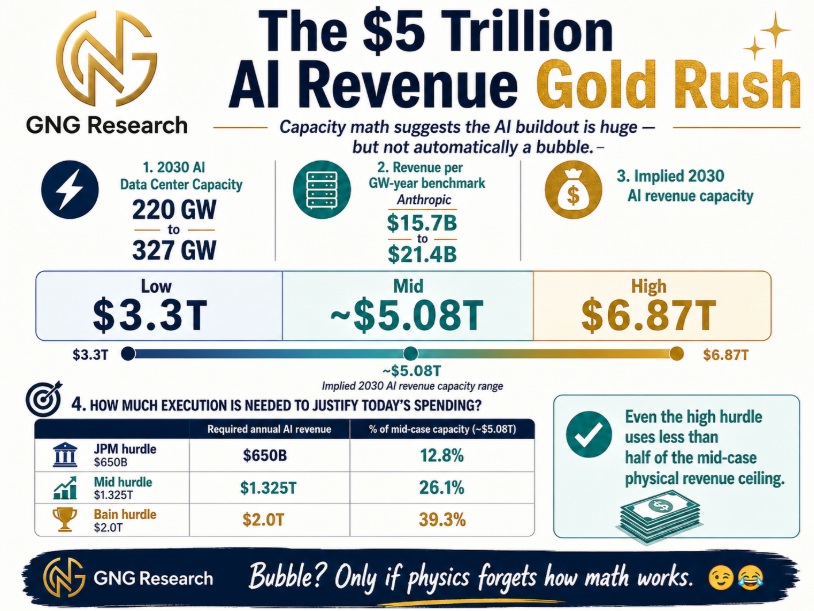

This is an experimental article series based on several days of research I was inspired to do this weekend. It involves initial brainstorming on the Adam GNG Chat thread, followed by extensive fact-checking with the AI research team, and then finally podcasts that were so educational and fun that I wanted to share them (along with really fun infographics) because you know, that’s peak Adam😉
The 3-part series is coming in 2 batches, parts 1 & 2 today, and the Nvidia update later.
Max AI revenue capacity in 2030 -->Max AI hyperscaler capex capacity -->NVDA earnings and thesis update (Max 2030 return potential).
We’re working on the YouTube Channel that will let you actually listen to the podcast (which are even more delightful!).
This series of report is NOT a forecast of what is most likely, it is designed as the fact-based way of estimating “How much more upside is there to the growth estimates that rise every quarter for 3 years so far?”
First here is the memo explaining the math. And then the podcast transcipt to make the math more fun, understandable and less crazy seeming.😉
Chairman's Memo — The Revenue Capacity of AI: $3.3 Trillion to $6.8 Trillion by 2030
GNG Research | May 25, 2026
Chairman Claude, on behalf of CIO Adam Galas
Last night we modeled the maximum capex capacity of the hyperscalers: approximately $4 trillion by 2030. Today we answer the other half of the question: what is the maximum revenue capacity of AI infrastructure, and how much of it needs to be monetized to justify today's spending?
The answer should make bubble-callers uncomfortable.
The capacity math.
Bessemer Venture Partners reports 190 GW of hyperscale data center capacity has been announced across 777 projects as of early 2026, with roughly 148 GW planned, 21 GW under construction, and 12 GW operational. Not all of this will be powered and connected on schedule — grid interconnection can take five to seven years even when construction finishes in 12 to 18 months — but even after adjusting for an 8 to 10% cancellation rate from local opposition, the pipeline is enormous.
By 2030, McKinsey and Goldman Sachs project global AI data center capacity reaching 220 to 327 GW. That is roughly 9 times the approximately 30 GW of operational capacity today.
The revenue-per-gigawatt benchmark.
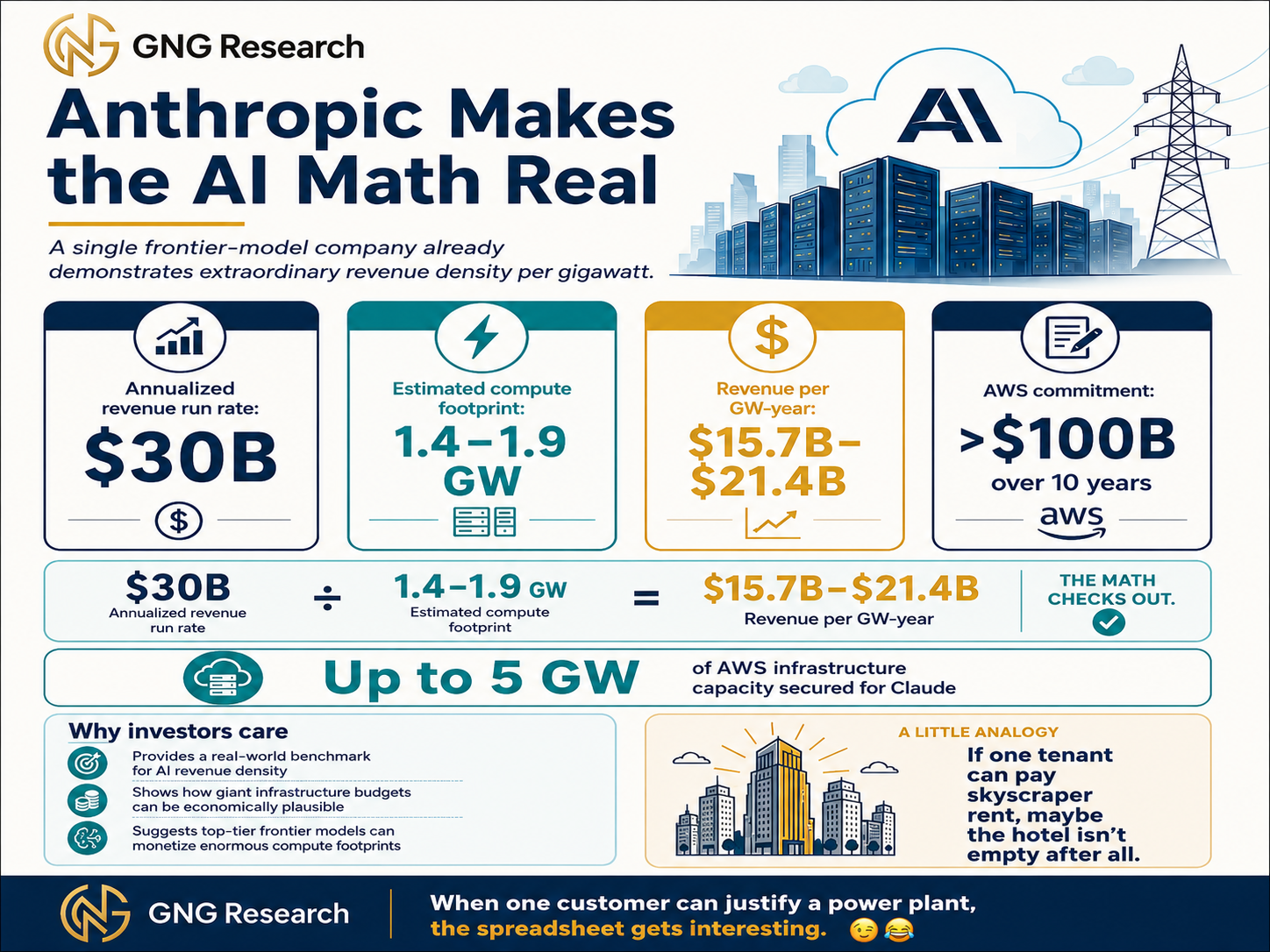
Anthropic's disclosed financials provide a useful benchmark. At a $30 billion annualized revenue run rate operating on an estimated 1.4 to 1.9 GW of compute capacity, Anthropic generates approximately $15.7 to $21.4 billion per gigawatt-year. The Anthropic-Amazon agreement confirms this scale: more than $100 billion committed over 10 years for up to 5 GW of capacity, which works out to roughly $2 billion per gigawatt-year in compute lease cost against $15 to $21 billion in revenue per gigawatt-year.
The revenue ceiling.
Multiply the capacity forecasts by the per-gigawatt revenue benchmark:
By mid-2028, adjusted capacity of roughly 170 GW implies a revenue capacity of $2.5 to $3.7 trillion per year.
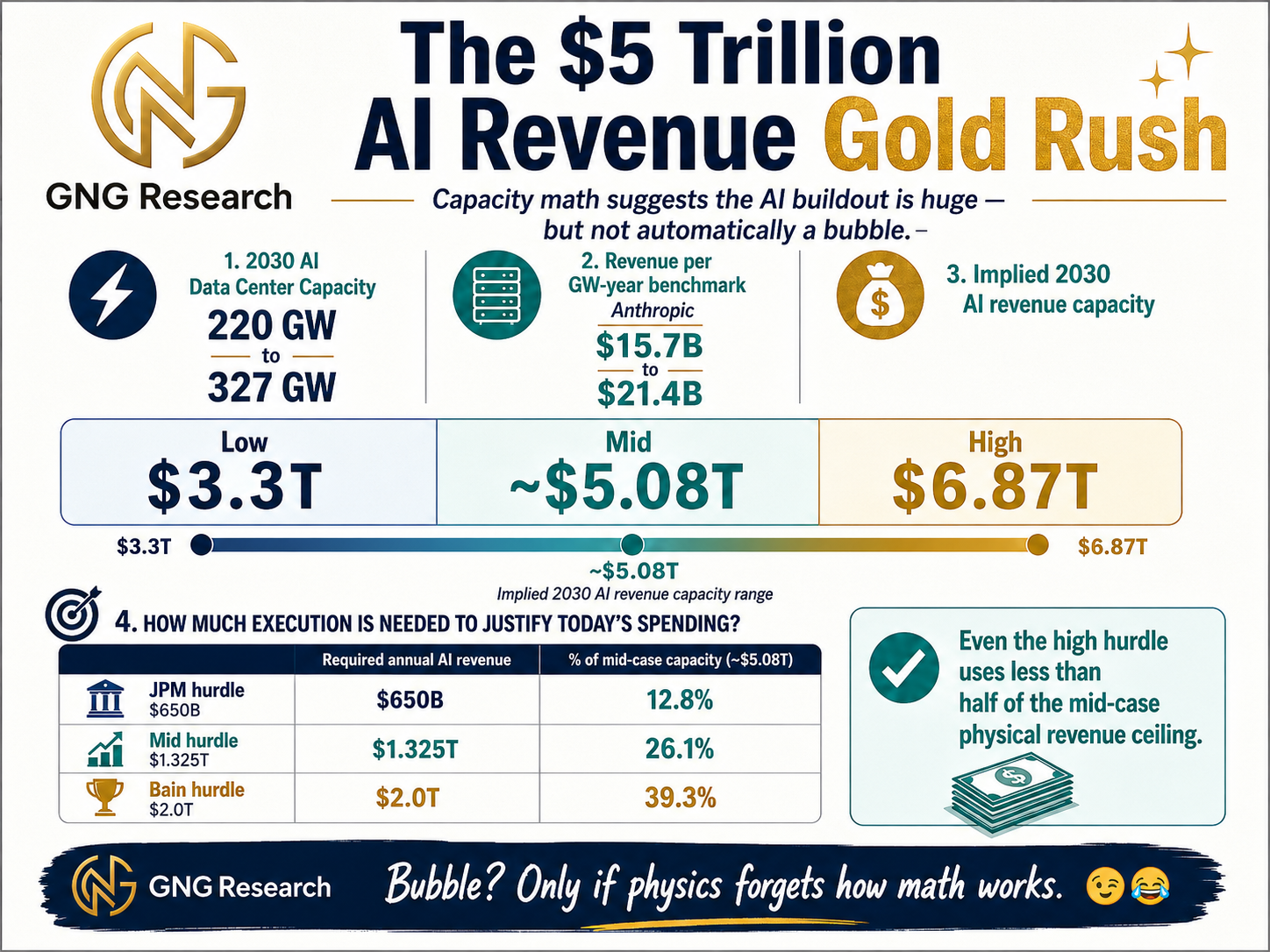
By 2030, at 220 to 327 GW, the revenue capacity reaches $3.3 to $6.8 trillion per year. The midrange is approximately $5 trillion.
How much needs to be monetized to justify today's spending?
J.P. Morgan estimates that $650 billion in annual AI revenue by 2030 would justify current capex levels. Bain's higher estimate is $2 trillion. Using those hurdles against the capacity range:
At J.P. Morgan's $650 billion hurdle and midrange capacity, only about 13% of revenue potential needs to be monetized. At Bain's $2 trillion hurdle and midrange capacity, the execution bar rises to roughly 39%.
Either way, the physical revenue ceiling is large enough that the buildout is not automatically a bubble. We need to achieve somewhere between one-eighth and two-fifths of the potential. Given that current demand is growing at 80 to 115% annually while maximum supply growth is approximately 55%, the math favors the builders.
The demand floor.
A 9x increase in capacity over 4.5 years requires approximately 63% annualized demand growth to maintain full utilization. Token demand has been doubling every 104 days for four years. Google disclosed 3.2 quadrillion tokens per month, up 330 times in two years. Even the most conservative recent growth figure from any major cloud provider — 7x annual token growth at Google — far exceeds the 63% floor needed to fill new capacity.
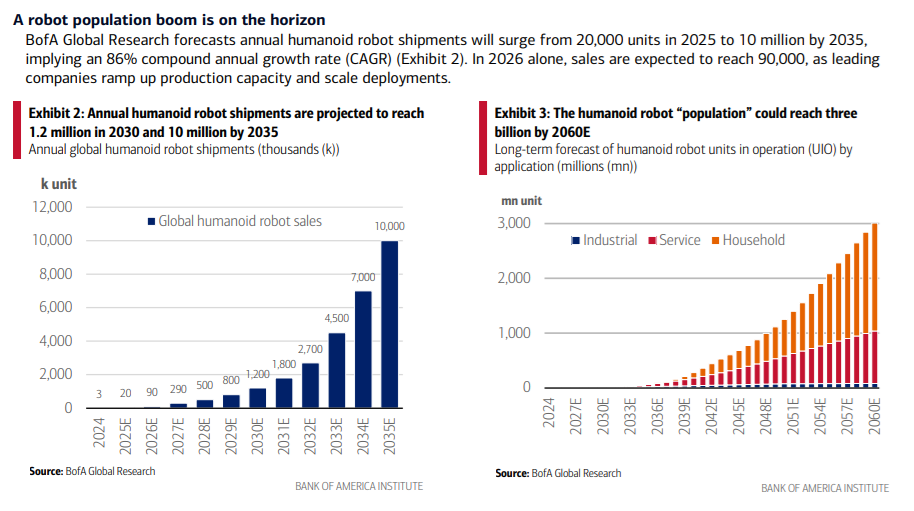
Agents and humanoid robots are accelerating this further. Bank of America estimates humanoid robot shipments growing from 20,000 last year to 10 million by 2035 at 86% annual growth. Each robot is a continuous token-generating machine.
The contracted scarcity argument.
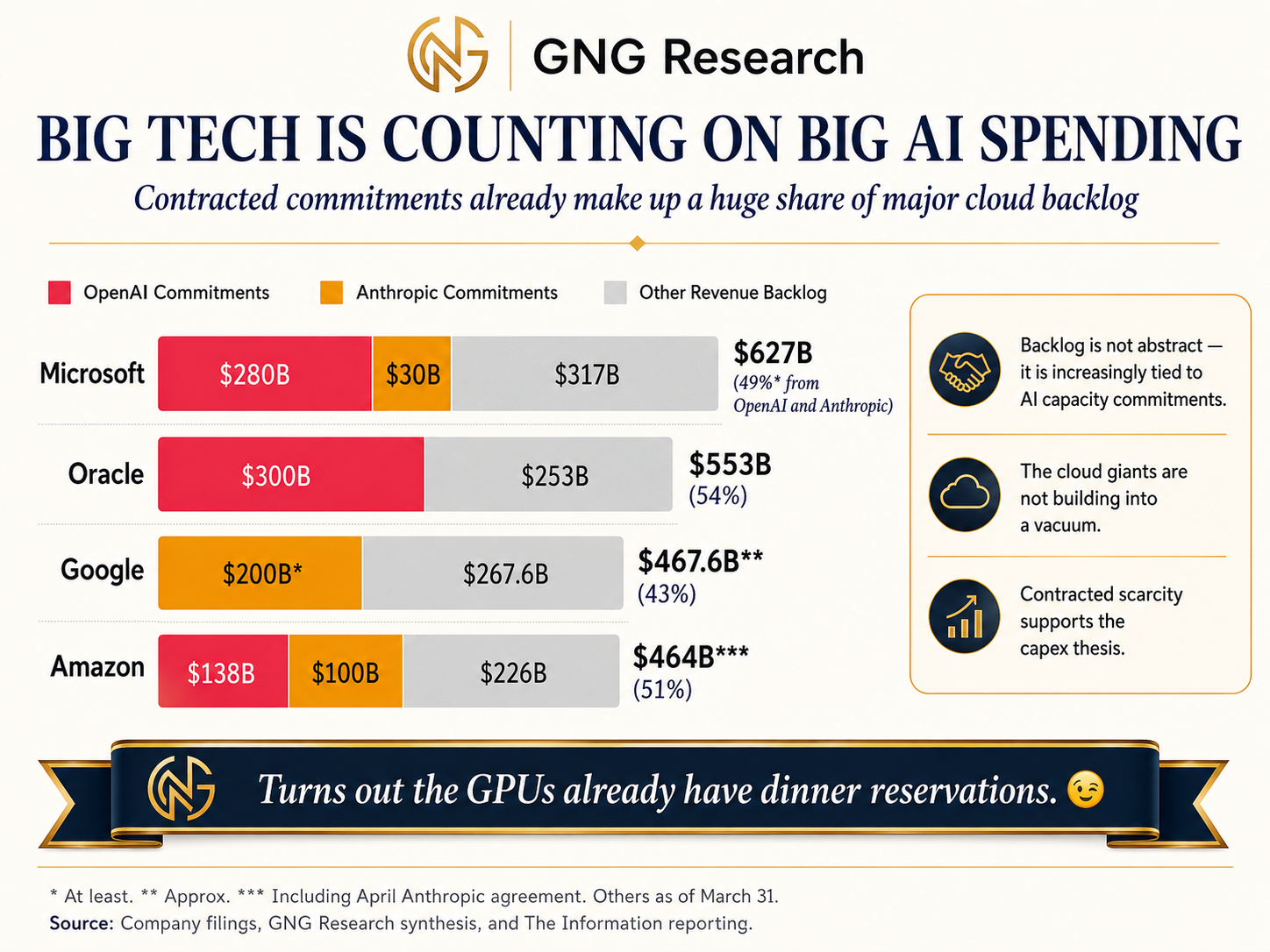
Hyperscalers reported 20 to 33% operating profit growth this quarter. Since it takes 1 to 3 years to build a data center, today's earnings are the return on capex from roughly 2 years ago. That is strong evidence that prior AI infrastructure investment is monetizing at approximately historical 20% cash returns on invested capital. The hyperscalers are building into contracted scarcity today just as they were 2 years ago. The RPO backlog across Amazon, Microsoft, Google, and Oracle now exceeds $2 trillion, growing at 80 to 115% depending on which providers are included.
The valuation bridge: why scary price-to-sales multiples can be rational.
At extreme margins, price-to-sales can look insane while price-to-earnings looks completely normal. The formula is simple: P/E equals P/S divided by net margin.
At 50% to 60% free cash flow margins, a company trading at 20 times sales is really trading at only 28 to 40 times earnings or free cash flow. That is not cheap in absolute terms, but for a dominant compounder growing at frontier rates, it is not bubble math either.
20 times sales sounds insane until the company converts 60 to 72% of revenue into free cash flow. Then it is just 28 to 40 times cash flow wearing a scary price-to-sales costume.
NVIDIA illustrates this perfectly. Using current forward consensus of approximately $391 billion in FY2027 revenue, NVIDIA trades at roughly 13 times forward sales. With elite margins, that translates to approximately 22 times forward earnings — historically cheap against a 10-year average forward PE of 36 and a 5-year average of 41. The stock is up 14 times since ChatGPT launched and the PE has gone down, because earnings grew faster than the price.
The quality framework: why this is not a casino.
Bessembinder's landmark research found that roughly the best-performing 4% of stocks accounted for all net U.S. stock market wealth creation above Treasury bills since 1926. J.P. Morgan found that 40 to 44% of stocks suffer catastrophic 70% or greater declines that never recover. The practical lesson is the same: durable quality — high returns on capital, strong balance sheets, long reinvestment runways, and defensible moats — is the filter that keeps you on the right side of those brutal odds.
Microsoft fell roughly 34% into the March 2026 low while its returns on invested capital remained stable at approximately 20% and its growth rate actually accelerated. On a forward valuation basis its multiple had compressed to roughly 19 times versus a historical norm around 35 times. A 40% discount on a AAA-rated company growing at 20% with intact fundamentals is not a broken stock. That is a blue-chip bargain hiding in plain sight.
The bottom line.
The AI revenue capacity of $3.3 to $6.8 trillion by 2030 means the current $725 billion capex buildout needs to monetize only 13 to 39% of physical capacity to be justified. Demand growth far exceeds the 63% floor needed to fill new capacity. Hyperscaler returns on prior capex are confirmed at historical levels. And the highest-quality companies in the AI infrastructure stack — NVIDIA, Microsoft, Amazon, Alphabet — are trading at historically cheap multiples relative to their growth.
This is not a bubble thesis. This is a capacity thesis. The question is not whether AI spending is too much. The question is whether the revenue ceiling is large enough to justify the investment. The answer, based on the best available data, is yes — with room to spare.
Research chain: Adam Galas (CIO), Claude 9 (transcription), Luna 4 (deep fact-check and corrections), Captain Harbor, Chairman Claude. Sources include Bessemer Venture Partners capacity data, McKinsey and Goldman Sachs 2030 projections, J.P. Morgan and Bain revenue hurdles, Anthropic official disclosures, NVIDIA Q1 FY27 earnings, and Google token-growth data.
The math is mathing. The capacity is capacitating. And the nerd was nerding from a hot tub because this is what peak Adam looks like. 🖖
🚀 The $5 Trillion AI Revenue Gold Rush of 2030: Decoding Infrastructure Bottlenecks, Moats, and the Market Bubble Illusion
Lex: Imagine building a 100-story mega hotel right in the middle of a major city.
Val: Okay, a massive skyscraper.
Lex: Right, a total skyscraper. And from the outside, the public is just looking at the billions of dollars being poured into the concrete, the glass, the endless construction crews.
Val: And they're probably thinking it's a huge waste of money.
Lex: Exactly. They scream, you know, "This is a massive boondoggle, you will never ever fill 100 floors of hotel rooms every single night."
Val: Which to be fair is a logical assumption if you don't know the internal math.
Lex: Yes, but what if that internal math of the developer proves that they only need to rent out the bottom 13 floors to completely pay the mortgage, cover the staff, and just break even on the entire colossal structure.
Val: Meaning everything from floor 14 all the way up to 100 is just pure profit.
Lex: Exactly. Everything else is gravy. And today we are applying that exact mathematical framework to the artificial intelligence boom. Because, you know, you look at the news and you see these staggering multi-trillion dollar numbers being thrown around for data centers, power grids, silicon...
Val: It's enough to make anyone's head spin.
Lex: It really is. And it is entirely natural for you, the listener, to sit back right now and wonder if we are living inside the biggest tech bubble in human history.
Val: I mean, it is basically the defining financial and technological question of our time right now.
Lex: Right. And the reason people feel that vertigo, that sense of impending collapse, is because the numbers are so large, they literally break our traditional mental models of how corporate spending is supposed to work.
Val: They just don't compute for a normal business.
Lex: No, they don't. When you see companies spending hundreds of billions of dollars on physical infrastructure before the consumer applications even fully exist...
Val: Well, the historical reflex is to just assume it's a bubble.
Lex: Okay, let's unpack this. Because today's deep dive is absolutely not about hype. We are setting all the vibes and the science fiction totally aside.
Val: Good, because there is way too much of that out there.
Lex: Way too much. We are not guessing what a chatbot or like a humanoid robot might be able to do in a decade. We are looking at a highly detailed stack of financial models, hyperscaler earnings reports, and infrastructure capacity forecasts.
Val: And we're talking heavy hitters here, right?
Lex: Oh, absolutely. That's from McKinsey, Goldman Sachs, JP Morgan. The mission for the next hour is to reverse engineer the actual literal math of the AI boom. We are going to calculate the physical limit of AI revenue by the year 2030 to see if this astronomical spending is mathematically justified.
Val: If we connect this to the bigger picture, what we are doing today is basically shifting our perspective from a demand thesis to a capacity thesis.
Lex: A capacity thesis. Break that down for us.
Val: Yeah, so when a new technology arrives, our first instinct is to measure the demand. Like how many people are logging in, how many enterprise licenses are actually being sold.
Lex: Which makes sense for traditional software.
Val: Right. But right now, in the age of AI, theoretical demand vastly outstrips the physical supply. When demand is essentially infinite, or at least far larger than what can currently be serviced, trying to measure it is a fool's errand. You have to calculate the choke points instead.
Lex: I really love that framing. We are not measuring the hype, we are measuring the choke points.
Val: Exactly. And the ultimate choke point, it isn't a line of code, it isn't some fancy algorithm, it's physical power. We are talking about literal gigawatts of electricity.
Lex: The heavy physical stuff.
Val: Yes. And according to the data we have from Bessemer Venture Partners, as of early 2026, there are 190 gigawatts of hyperscale data center capacity announced across 777 projects globally.
Lex: To truly grasp the scale of that number, we have to look at what a gigawatt actually represents in the real world.
Val: Right, because most people don't deal in gigawatts on a daily basis.
Lex: No, of course not. So, um, a single gigawatt of power is roughly equivalent to the energy consumption of a medium-sized city.
Val: Like, how big of a city are we talking?
Lex: Think San Francisco.
Val: Wow.
Lex: Yeah. So, an announced pipeline of 190 gigawatts is the equivalent of planning to build the power draw of 190 new San Franciscos purely to run computation.
Val: That is just mind-blowing.
Lex: It is a foundational rewiring of global energy consumption. AI is simply the most power-intensive workload in the entire history of computing.
Val: But having a pipeline on paper is, you know, very different from having that power actually flowing into servers.
Lex: No, very different. Because if we break down that 190 gigawatt number, reality starts to hit you in the face pretty fast. Out of that 190 gigawatts, approximately 148 gigawatts are strictly in the planning stages.
Val: Just blueprints right now.
Lex: Exactly. About 21 gigawatts are currently under construction. And only 12 gigawatts of that specific announced pipeline are actually operational today.
Val: Which is a tiny fraction.
Lex: It really is. To put that in perspective, the total current global capacity for all AI data centers right now is roughly 30 gigawatts.
Val: And this brings us right to the critical bottleneck. Because the physical construction of a data center, you know, pouring the concrete, erecting the steel, installing the massive liquid cooling systems, and racking all the servers. That can actually be done relatively quickly.
Lex: Right, they've gotten pretty good at building the actual shells.
Val: Yeah, a hyperscaler can stand up a physical shell in about 12 to 18 months. But connecting that building to the national power grid? That is an entirely different beast.
Lex: That's where things grind to a halt.
Val: Exactly. The data shows that grid connection currently takes anywhere from 5 to 7 years.
Lex: 5 to 7 years just to plug the building in!
Val: Yeah. I mean, if you are listening to this and thinking, "Wait, why on earth does it take half a decade to plug a building into the wall?"
Lex: Right.
Val: We have to look at the mechanisms of the power grid. It is not just about running a long extension cord.
Lex: Far from it. You are dealing with the actual physics of high-voltage electricity here.
Val: Yeah. To safely draw that much power from the grid without causing, say, rolling blackouts in the surrounding region, you need massive new substations.
Lex: Like, whole new pieces of infrastructure.
Val: Right. You need high-voltage transmission lines. You need these highly specialized house-sized electrical transformers.
Lex: House-sized?
Val: Literally the size of a house. And currently, there is a massive global supply chain shortage for those specific high-voltage transformers.
Lex: So you can't even buy them if you want to.
Val: No, the queue to simply purchase one is literally years long. Furthermore, the existing electrical grid, in places like the US, was simply not designed for a single corporate facility to draw the power of a major municipality 24 hours a day, 7 days a week.
Lex: And beyond the physics and the supply chain, you have the human element, right? Because the data shows a really significant local opposition factor emerging.
Val: NIMBYism is a real bottleneck here.
Lex: Exactly. In the US alone, roughly 8% to 10% of these massive data center projects are facing severe delays or outright cancellation just because of pushback from local communities.
Val: People get nervous when a facility like that comes to town.
Lex: Naturally. They are worried about the strain on their local power rates, the immense amount of water required for cooling these servers, and just the sheer physical footprint of the facilities.
Val: It creates a fascinating, and honestly, somewhat absurd geopolitical reality.
Lex: How so?
Val: Well, the limiting factor for the deployment of the most advanced technology in human history isn't the availability of advanced silicon chips. And it isn't the ingenuity of software engineers in Silicon Valley.
Lex: Right.
Val: The limiting factor is literally a local zoning board in a suburb deciding whether or not to approve a new substation.
Lex: That is wild when you put it like that.
Val: But I have to push back on this timeline a bit, because the numbers from the heavy hitters seem to totally contradict this reality.
Lex: Let's hear it.
Val: You look at McKinsey and Goldman Sachs, and they were projecting that global AI data center capacity will hit somewhere between 220 gigawatts and 327 gigawatts by the year 2030.
Lex: Those are massive projections.
Val: Right. If we are currently at roughly 30 gigawatts globally, that is a massive 9x increase in capacity over just four and a half years. So how is a 9x increase physically possible if we just established that a grid connection takes seven years?
Lex: That is the central tension of this entire industry right now. And the answer is that the major technology companies, these hyperscalers, they are not going to patiently wait in a seven-year queue for the US grid to modernize.
Val: They can't afford to wait.
Lex: No. If the domestic grid is the bottleneck, capital and infrastructure will flow like water to the path of least resistance. We are already seeing these companies look outside their traditional hubs.
Val: Where are they going?
Lex: Well, they are looking at regions like the Middle East, for example.
Val: Oh, interesting.
Lex: Yeah, because governments there are highly motivated to diversify away from oil. And they can offer abundant, rapidly accessible power with far, far less regulatory friction.
Val: So they basically skip the zoning board entirely.
Lex: Precisely. They're also exploring stranded power assets like locations where power is currently generated but severely underutilized.
Val: So, to use an analogy, it's like trying to measure the ocean by looking at the water, when what we really should be doing is looking at the size of the bathtub we are trying to fill.
Lex: That's a great way to look at it. The software demand doesn't matter if the physical concrete and copper wire aren't there to carry it. The capacity constraint is the absolute only metric that truly dictates the speed of the revolution.
Val: And what McKinsey and Goldman are essentially telling us is that the bathtub is going to expand from 30 units today to potentially 327 units by 2030.
Lex: Which is an incredibly expensive bathtub.
Val: Unbelievably expensive. To build that kind of infrastructure requires a staggering $5.2 trillion in total compute infrastructure investment.
Lex: Which naturally leads us to the multi-trillion dollar question.
Val: Wow.
Lex: How do you actually pay for a $5.2 trillion build-out? Because just pouring concrete and drawing gigawatts of power doesn't pay dividends on its own.
Val: It just burns cash.
Lex: Exactly. We have to figure out how the industry turns that raw physical power into actual dollars. We need to establish the physical revenue ceiling of this entire endeavor.
Val: And to establish a revenue ceiling, we need a baseline metric. We need a real-world proven example of exactly how much money a single gigawatt of AI compute can generate when a frontier model is actually running at scale.
Lex: So we aren't just guessing?
Val: Right, no guesswork. And in our source material, the clearest benchmark we have for this conversion rate right now is Anthropic.
Lex: Okay, let's walk through the math on Anthropic step-by-step, because this is where the abstract concepts turn into hard, undeniable economics.
Val: Walk us through it.
Lex: So Anthropic recently reported an annualized revenue run rate that surpassed $30 billion. Now, to generate that $30 billion in software revenue, they operate on an estimated physical compute footprint of roughly 1.4 to 1.9 gigawatts.
Val: So the arithmetic here is incredibly illuminating.
Lex: It really is. Because if you take their $30 billion in revenue and you simply divide it by that 1.4 to 1.9 gigawatt footprint, you arrive at a highly specific monetization metric.
Val: Which comes out to what?
Lex: It yields roughly $15.7 billion to $21.4 billion in revenue per gigawatt year.
Val: That's huge.
Lex: It is. That is the current, real-world conversion rate of raw electricity into artificial intelligence revenue.
Sign in to leave a comment and join the discussion.
Sign Up Free